We live in a world driven by data.
From our online shopping and banking transactions to our website clicks, mobile app usage and social media, nearly every time we take an action, data is captured. However, the initial collection of that data is only the first stage. The biggest hurdle to overcome once you collect the data is being able to turn that data into actionable information that will enable companies to make informed decisions.
This is where the KDD process in data mining plays a major role.
KDD is a well-organized approach that assists in discovering meaningful patterns and insights that are hidden within vast amounts of data. KDD is intended to help organizations move beyond basic storage of data and begin employing data to address real-world business issues.
In this blog, we will clarify what is KDD in data mining and review each stage of the KDD process while demonstrating that KDD continues to be an integral component of what data professionals do today.
What is KDD in Data Mining?
KDD (Knowledge Discovery in Databases) is the process of extracting useful knowledge from large collections of data.
The goal of KDD is not just to analyze data but to discover patterns, trends, relationships, and insights that can support business decisions.
Many people confuse KDD with data mining, but they are not exactly the same.
Data mining is one step within the larger KDD framework. KDD covers the complete journey of transforming raw data into valuable knowledge.
KDD Full Form in Data Mining
KDD = Knowledge Discovery in Databases
It refers to the entire process of finding meaningful information from large datasets using various analytical and computational techniques.
Why is the KDD Process Important?
Organizations today collect massive amounts of information, but raw data alone has little value.
The KDD process helps businesses understand customer behavior, improve operations, identify opportunities, and make data-driven decisions.
For example:
Customer Data → Analysis → Insights → Better Business Decisions
Without a structured process like KDD, organizations may struggle to extract meaningful value from their data.
This is why KDD remains relevant in fields such as:
→ Data Engineering
→ Data Analytics
→ Machine Learning
→ Business Intelligence
→ Artificial Intelligence
KDD Process in Data Mining
The KDD process consists of several stages that work together to transform raw data into actionable knowledge.
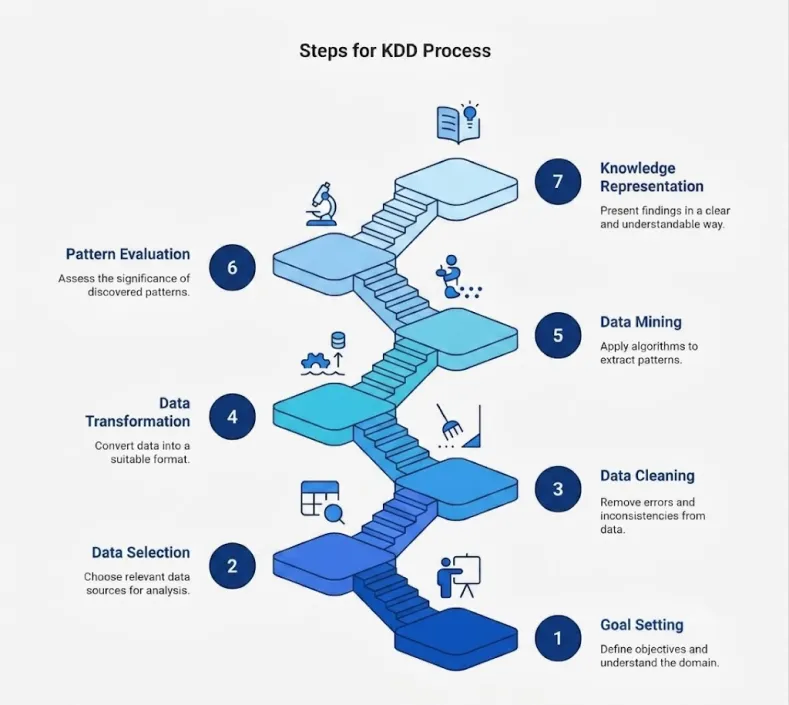
| Stage | Purpose |
|---|---|
| Data Selection | Choose relevant data for analysis |
| Data Cleaning | Remove errors and inconsistencies |
| Data Integration | Combine data from multiple sources |
| Data Transformation | Convert data into a suitable format |
| Data Mining | Discover patterns and relationships |
| Pattern Evaluation | Identify useful findings |
| Knowledge Presentation | Present insights to stakeholders |
The overall flow looks like this:
Data Selection → Data Cleaning → Data Integration → Data Transformation → Data Mining → Pattern Evaluation → Knowledge Presentation
Let's understand each stage with a practical example.
1. Data Selection
The first step involves identifying and collecting relevant data.
Businesses often store information across multiple systems such as databases, applications, cloud platforms, and customer management tools. Not all available data is useful for every problem.
The objective is to select only the information required for analysis.
For example, if an e-commerce company wants to understand customer purchasing behavior, it may focus on customer profiles, order history, and product data instead of collecting every available record.
Selecting the right data helps improve both efficiency and accuracy.
2. Data Cleaning
Once data is selected, it must be cleaned.
Real-world datasets often contain missing values, duplicate records, incorrect entries, and inconsistent formats. These issues can significantly affect the quality of analysis.
Consider a customer database where the same customer appears multiple times due to system errors. If duplicates are not removed, reports and predictions may become inaccurate.
Data cleaning ensures that the dataset is reliable before further processing begins.

3. Data Integration
Organizations rarely keep all their information in one place.
Customer data may exist in a CRM system, transaction data in a database, and marketing data in a separate analytics platform.
The integration stage combines information from these different sources into a unified dataset.
For example:
CRM Data + Sales Data + Website Analytics → Unified Customer View
This consolidated view helps businesses gain deeper insights that would be difficult to obtain from isolated datasets.
4. Data Transformation
After cleaning and integration, the data is transformed into a format suitable for analysis.
This stage may include:
→ Aggregating data
→ Standardizing formats
→ Creating new features
→ Reducing unnecessary information
For example, instead of analyzing millions of individual transactions, a company may calculate monthly sales summaries to identify long-term trends more effectively.
Transformation prepares the data for the next and most recognized stage of the KDD process.
5. Data Mining
Data mining is where actual pattern discovery takes place.
Using statistical techniques, machine learning algorithms, and analytical models, organizations identify relationships hidden within the data.
Common data mining applications include:
→ Customer segmentation
→ Recommendation systems
→ Fraud detection
→ Sales forecasting
→ Churn prediction
Imagine an online retailer discovering that customers who purchase laptops often buy laptop accessories within the next few days.
Such insights can directly influence marketing campaigns and product recommendations.
6. Pattern Evaluation
Not every discovered pattern is useful.
The evaluation stage focuses on determining which findings are meaningful and aligned with business goals.
For example, discovering that sales increase during major holiday seasons may be highly valuable. On the other hand, random correlations with no practical business impact can be ignored.
This stage helps organizations focus on insights that create measurable value.
7. Knowledge Presentation
The final stage involves presenting the results in a clear and understandable format.
After all, insights are only useful if decision-makers can understand and act upon them.
Organizations commonly use:
→ Dashboards
→ Reports
→ Visualizations
→ Business Intelligence Tools
A sales dashboard showing revenue growth, customer retention, and product performance enables leadership teams to make informed decisions quickly.
At this stage, the KDD process successfully transforms raw data into actionable business knowledge.
Real-World Example of KDD
Let's consider a streaming platform such as Netflix.
The company collects data about user viewing behavior, watch time, search history, and content preferences.
The KDD process may look like this:
User Activity Data → Data Cleaning → Data Integration → Pattern Discovery → Personalized Recommendations
As a result, users receive movie and show recommendations tailored to their interests.
This improves customer engagement while increasing platform retention.
KDD vs Data Mining
One of the most frequently asked questions is the difference between KDD and Data Mining.
| KDD | Data Mining |
|---|---|
| Complete knowledge discovery process | One stage within KDD |
| Includes preparation, evaluation, and presentation | Focuses on finding patterns |
| Broader concept | Narrower concept |
| Goal is useful knowledge | Goal is pattern extraction |
In simple terms, data mining is a component of KDD, while KDD represents the entire workflow.
Why Data Professionals Should Learn KDD
Modern organizations expect data professionals to understand the complete data lifecycle rather than just individual tools.
Whether you work as a Software Engineer, Data Analyst, Data Engineer, or Machine Learning Engineer, understanding KDD helps you see how data creates business value.
Today's data engineers are responsible for building pipelines that collect, process, transform, and deliver data for analytics and AI applications. Concepts within the KDD process are reflected in real-world technologies such as SQL, Apache Spark, Kafka, Airflow, Databricks, and cloud-based data platforms.
This is one reason many working professionals pursue structured learning paths through programs such as the Bosscoder Academy Data Engineering Program. Along with modern data engineering tools, professionals gain exposure to real-world data workflows, mentorship, projects, and interview preparation that help bridge the gap between theory and industry requirements.
Understanding KDD provides the foundation, while hands-on experience with modern data systems helps professionals apply these concepts at scale.
Conclusion
The KDD process in data mining is a systematic approach to discovering valuable knowledge from raw data. It involves multiple stages, including data selection, cleaning, integration, transformation, data mining, pattern evaluation, and knowledge presentation.
As organizations continue to rely on data-driven decision-making, understanding KDD has become increasingly important for modern technology professionals.
Whether you're planning a transition into Data Engineering, working with analytics teams, or building machine learning systems, a strong understanding of the KDD process will help you understand how raw data ultimately becomes actionable business intelligence.
Frequently Asked Questions (FAQs)
Q1. What is the KDD process in data mining?
The KDD (Knowledge Discovery in Databases) process is a systematic approach to extracting valuable knowledge from large datasets. It includes data selection, data cleaning, data integration, data transformation, data mining, pattern evaluation, and knowledge presentation. The objective is to turn raw data into meaningful insights that support business decision-making.
Q2. What is the difference between KDD and data mining?
KDD is the complete process of discovering useful knowledge from data, while data mining is only one stage within that process. Data mining focuses on identifying patterns and relationships, whereas KDD also includes data preparation, evaluation, and the presentation of insights. In simple terms, data mining is a subset of KDD.
Q3. How can I learn the KDD process and apply it in real-world projects?
The best way to learn the KDD process is by combining theoretical concepts with hands-on projects involving data cleaning, transformation, analytics, and machine learning. Programs such as the Bosscoder Academy Data Program help professionals understand how KDD concepts are applied using industry tools like SQL, Apache Spark, Kafka, Airflow, and Databricks through real-world projects, mentorship, and practical learning.