

There have been shifts in how businesses develop their products and automate their tasks due to artificial intelligence. However, turning an AI product or software solution into a production-grade solution can be difficult.
Every company has unique sets of data, systems, processes, and requirements.
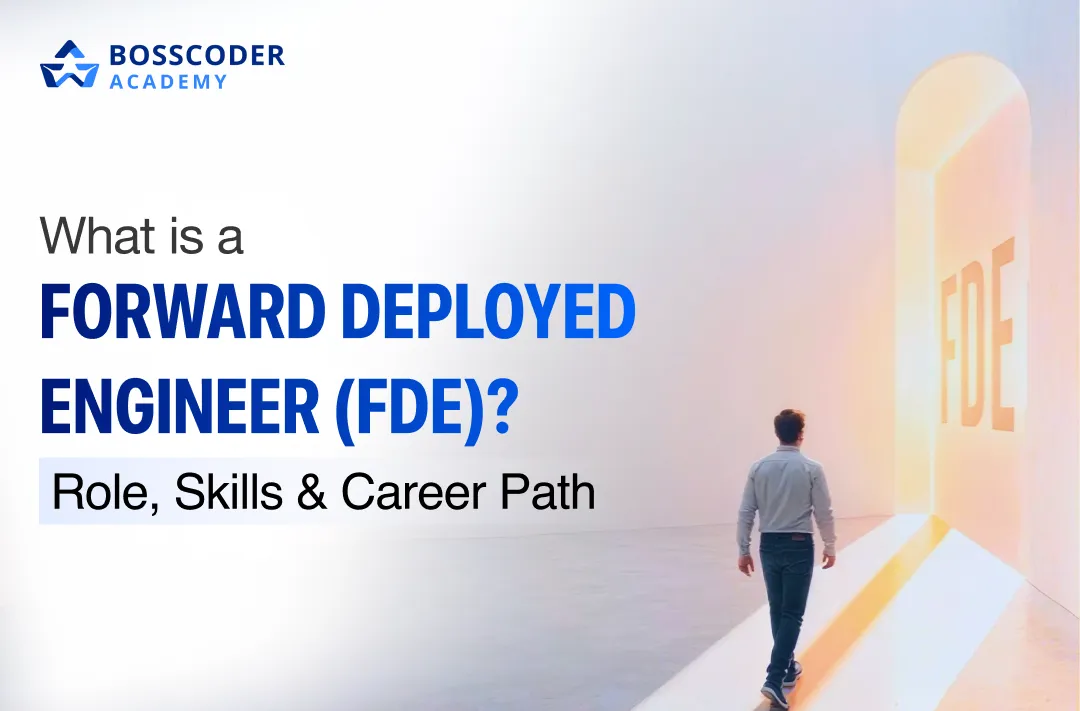
This is when a Forward Deployed Engineer (FDE) comes into play.
This role is a combination of software engineering, AI, system architecture, problem-solving, and customer relations skills.
What Is a Forward Deployed Engineer?
The Forward Deployed Engineer (FDE) is a software engineer that works in close contact with the customers and the business to learn about their problems and implement technological solutions to those problems.
In other words:
Forward Deployed Engineer makes technology work for a real customer in a real world.
They may become familiar with a customer's workflow, design a solution, create a prototype, integrate with the existing systems, deploy the solution in production and improve it based on the real-world experience.
For instance, a company might want to leverage the potential of an AI-based solution to automate its workflow. In this case, The engineer will have to understand the workflow of the client, integrate the system with existing components, develop the necessary application, test it, deploy it, and validate its efficiency.
OpenAI's Forward Deployed Engineering team works with clients to transform research innovations into production systems. The current FDE role involves the following tasks: discovery, technical scoping, system design, development, production deployment, and adoption.
What Does a Forward Deployed Engineer Do?
It will depend on the individual company, but the job description of a Forward Deployed Engineer is typically rather straightforward:
Understand → Design → Build → Deploy → Improve
1. Understanding the Problem
A Forward Deployed Engineer starts with understanding the problem that needs to be solved.
It involves:
- Analyzing the current workflow
- Getting the understanding of business requirements
- Looking at the data
- Understanding the technical limitations
- Talking to engineers
- Defining measurable outcomes
The goal is to clearly define the business problem before building a technical solution.
2. Design the Solution
After clearly defining the problem, the engineer determines how technology can be used to build a practical technical solution.
Depending on the particular project, the solutions will require:
- APIs and integrations
- Back and front-end systems
- Databases
- Cloud solutions
- AI and LLM applications
- Data pipelines
- Automation
- Systems architecture
The FDE also needs to make practical trade-offs between speed, scope, quality, cost, and reliability.
3. Build the Solution
Forward Deployed Engineers are hands-on software engineers.
They can code, prototype, integrate APIs, build AI applications, debug technical problems, and build production systems.
This hands-on engineering is an integral part of the job. It is worth mentioning that in the FDE job description from OpenAI, the development of full-stack systems and contributing to the code is listed as a responsibility.
4. Deploy and Support the Solution
Developing a prototype is just a start.
The engineer helps deploy the solution into production and troubleshoot problems that arise during implementation.
It could be:
- Testing
- Integration
- Data problems
- Performance
- Security requirements
- Monitoring
- Adoption
5. Learn and Improve
Working with actual users is an important part of the role.
Therefore, the engineer receives direct feedback on what works and what does not.
Such feedback will help to improve the solution and share insights with product and engineering teams.
Getting such feedback is a vital part of modern FDE work. It is stated in OpenAI's FDE job description that field feedback is supposed to be provided.
Forward Deployed Engineer vs Software Engineer
While both the FDE and the software engineer require excellent engineering skills, there are differences in what each focuses on.
| Area | Software Engineer | Forward Deployed Engineer |
|---|---|---|
| Primary focus | Improving and building products | Solving specific customer problems |
| Environment | Product/engineering Team | Customer and Engineering Environment |
| Interaction with customer | Usually limited | Usually high |
| Development | Features/systems of the product | Prototypes, integration and production |
| Requirements | Specified by product teams | Discovered in the customer environment |
| Success | Product quality and delivery | Customer adoption and business impact |
An easy way to recall the difference:
Software engineers often focus on building and improving the product. A forward deployed engineer applies engineering to solve specific customer problems and make the product work in real-world environments.
This line may not be hard and fast.
The boundary is not always fixed. Some companies define FDE roles differently, and modern FDE positions can combine software engineering, product thinking, technical delivery, and customer collaboration.
FDE vs Solutions Engineer vs Solutions Architect
FDE roles can be compared with similar customer facing technical roles too.
| Role | Main Focus | Coding | Customer Interaction |
|---|---|---|---|
| Forward Deployed Engineer | Build & Implementation of technical solution | High | High |
| Software Engineer | Design & Development of product/platform | High | Low to Medium |
| Solutions Engineer | Technical discovery and product fit | Medium | high |
| Solutions Architect | Architecture & Planning of technical solution | Medium | High |
| Implementation Engineer | Integration & Deployment of technical solution | Medium to High | High |
While these roles can overlap, their responsibilities often differ. A Solutions Engineer typically focuses on demonstrating, configuring, or integrating a product for a customer, while a Solutions Architect generally focuses on designing the broader technical architecture. A Forward Deployed Engineer is typically more hands-on with building, deploying, and iterating on the technical solution.
What Skills Does a Forward Deployed Engineer Need?
Being a Forward Deployed Engineer means having technical and problem-solving expertise.
1. Software Engineering
Having good engineering principles is crucial. Strong software engineering fundamentals form the foundation of a forward deployed engineering career.
Required skills are:
- Knowledge of Python, JavaScript, Java, or any other programming language
- APIs
- Databases
- Git
- Backend
- Debugging
- Testing
- Software architecture
2. System Design
The job of an FDE involves dealing with system-level solutions and not just individual features.
These skills help an engineer design systems that can integrate with existing infrastructure while remaining reliable and scalable.
Key concepts include:
- System architecture
- APIs and integration
- Data flow
- Scalability
- Reliability
- Cloud computing
- Security
3. AI and LLM Skills
AI is becoming more relevant for FDE positions, especially with regard to enterprise technology.
Areas that may be helpful include:
- Large Language Models (LLMs)
- Prompt engineering
- RAG
- AI agents
- Tool calling
- LLM APIs
- AI evaluation
- LLMOps
The current position of FDE at OpenAI specifically requires experience with systems utilizing LLMs or generative models.
4. Problem Solving
Customer problems are rarely stated clearly.
It is up to the FDE to transform a business problem into a technical problem and solve it.
5. Communication
FDEs deal with engineers, the business, the customer, and many other stakeholders.
They have to communicate:
- Technical decisions
- Architecture
- Trade-offs
- Limitations
- Risks
- Expected outcomes
Good communication makes the FDE fast and technically precise at the same time.
What Makes Forward Deployed Engineering Different?
Traditional software engineering often begins with defined product requirements and focuses on delivering functionality. Forward deployed engineering is more focused on applying engineering to specific customer and business problems.
FDE is more results-driven:
Customer Problem → Discovery → Design of Solution → Prototype → Develop → Deploy → Measure → Improve
This makes forward deployed engineering a customer-facing engineering discipline, where technical decisions are closely connected to business outcomes and real-world usage.
The link with the customer’s environment means that problems that would otherwise go unnoticed in a typical product development process can be uncovered by FDEs.
Forward deployed engineering is very helpful in situations where companies need to handle complex integration issues, AI solutions, or any other unique environment.
Why Is Forward Deployed Engineering Important for AI?
AI models may be very effective, however, it doesn’t mean that the model will solve the business problem on its own.
An AI-based solution deployed in production may require integration with:
- Company’s data
- Applications used
- Workflows inside the company
- APIs
- Security measures
- Users’ permission system
- Evaluation systems
- Production environment
This is where a forward deployed engineer can help connect AI capabilities with the customer's existing technology environment.
This is why modern AI companies are building FDE teams that will collaborate directly with their clients and help them deploy AI models into production.
FDE teams in OpenAI are currently described by their creators as “bridging the gap between customer delivery and core platform.”
Who Is a Good Fit for an FDE Role?
A career as a Forward Deployed Engineer can suit professionals who enjoy software engineering as well as solving real-world business problems.
If you...
- Like developing solutions
- Are interested in solving unclear problems
- Would like to do things related to AI
- Enjoy system design
- Like working with customers or businesses
- Are fast learners of new technologies
- Would like to see how your engineering skills help
- Like change and not doing the same thing each time
... then FDE work might be right for you. But keep in mind that FDE requires quite a lot of effort from you.
AI Forward Engineer Program by Bosscoder Academy
For professionals interested in the intersection of AI, software engineering, system design, and real-world deployment, Bosscoder Academy's AI Forward Engineer Program focuses on practical skills relevant to modern AI engineering and forward deployed engineering roles.
Some areas covered by the program include:
| Learning Area | Focus |
|---|---|
| Generative AI | LLMs, prompting and AI application building |
| RAG | Building retrieval-based AI systems |
| Agentic AI | Agents, tools and multi-step workflows |
| System Design | Designing scalable and reliable systems |
| LLMOps | Deployment, evaluation, and improvement of AI systems |
| Forward Deployed Engineering | Customer problem, solution design, deployment, and business impact |
The program also focuses on applying technical skills to real-world AI solutions, deployment, and customer-specific problems.
The point of the program is not only to learn one more framework for AI.
The main idea is to be able to detect a problem, pick up a technology for it, build a solution, deploy it, evaluate it, and make improvements based on real-world outcomes.
Conclusion
A Forward Deployed Engineer (FDE) stands at the intersection of software engineering, artificial intelligence, system architecture, and client solutions.
Being an FDE means more than writing code; it means leveraging technology to become deployable, usable, and valuable in real environment.
As more technology companies move AI from research and experimentation into production environments, forward deployed engineers can help bridge the gap between AI capabilities, technical systems, and business requirements.
For tech professionals interested in this career direction, the most valuable combination is:
Strong Engineering + AI Skills + Systems Design + Problem Solving + Communication
This is exactly what Bosscoder Academy’s AI Forward Engineer Program aims to achieve.
Frequently Asked Questions About FDE
Q1. What is a Forward Deployed Engineer?
A Forward Deployed Engineer is a software engineer who interacts with customers and business teams, understanding their problems, and developing technical solutions that solve them.
Q2. What is the job of a Forward Deployed Engineer?
The FDE understands problems of customers, designs solutions for them in technical terms, codes, integrates, deploys the application and improves solutions based on real world feedback.
Q3. Is a Forward Deployed Engineer a software engineer?
Yes, usually, the Forward Deployed Engineers are software engineers, but there are some differences in their roles. They work much closer with the customers solving their problems than just focusing on software.
Q4. What skills does a Forward Deployed Engineer need?
The most important skills of an FDE are software engineering, system design, APIs, cloud technologies, AI and LLMs, problem-solving, communication and deployment.
Q5. What is the difference between an FDE and a software engineer?
Generally, the software engineer is concerned with development and enhancement of the product/platform itself while the FDE is concerned with deploying engineering capabilities to solve particular customer problems.
Q6. What does FDE stand for?
FDE stands for Forward Deployed Engineer. The role typically combines software engineering, system design, problem-solving, customer collaboration, and production deployment.